Book direct from the host·Hosts keep 100%·No commission, no feesBook direct · Hosts keep 100% · No fees

0 properties available
Fewer than 3 percent of Iceland's tourists ever make it to the Westfjords. The peninsula reaches into the North Atlantic from Iceland's northwest corner, looks like a gnarled lobster claw on the map, and contains roughly 22,000 square kilometres of fjord, mountain, and cliff. Around 7,000 people live in it. The Ring Road skips the entire region and most travellers don't have the extra 2 to 4 days needed to detour. That is exactly why this region is worth the detour.
Getting here takes effort. The drive from Reykjavík to Ísafjörður (the largest town) is around 5 hours and 410 km. Many of the most worthwhile roads inside the peninsula are single-lane gravel with steep mountain passes, blind corners, and no shoulder. You will average 50 km/h on the better stretches and 30 km/h on the rougher ones. They are not F-roads, so a regular rental car is fine in summer, but the journey is slow and demanding.
The Stykkishólmur to Brjánslækur ferry across Breiðafjörður is the cheat code: it cuts roughly 4 hours off the drive in both directions if you are coming from or going to Snæfellsnes. It runs once or twice a day in summer (Baldur, around 2.5 hours each way). Booking ahead in July and August is sensible.
The region is effectively a summer destination. Most travel resources call it open mid-May to mid-September. In winter, severe snow can close the airports for weeks at a time, road crews are stretched thin, and entire valleys can be isolated.
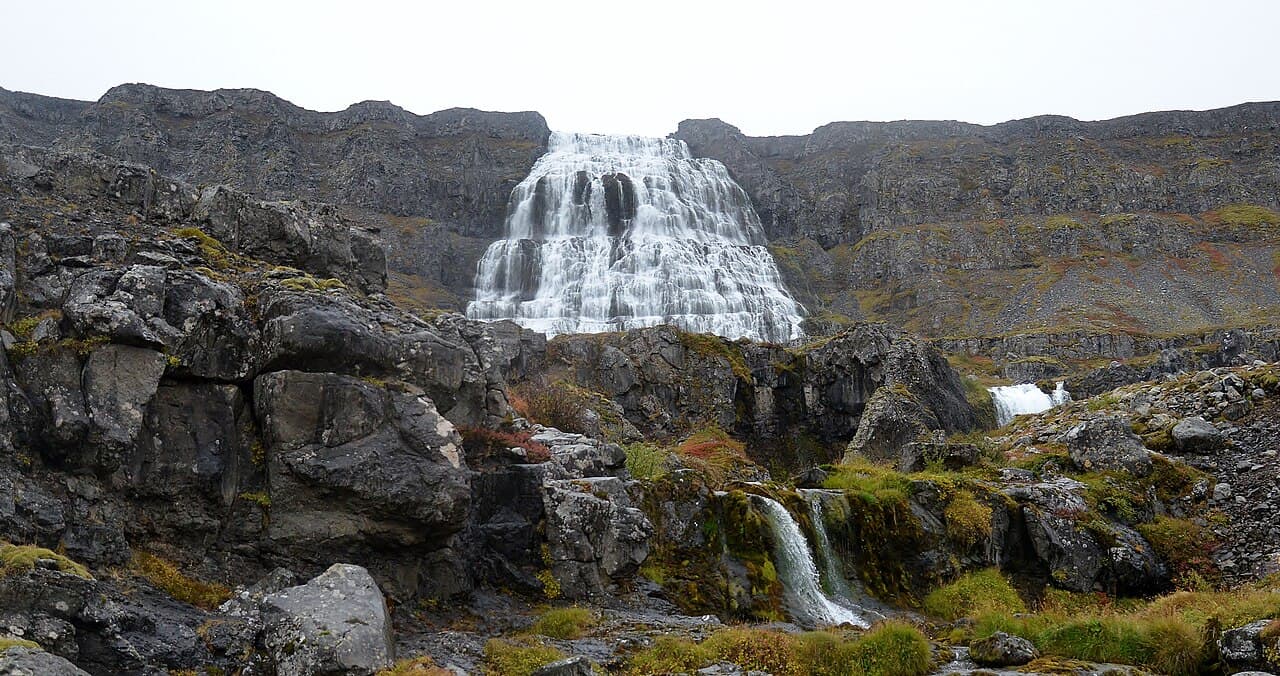
Dynjandi is the region's headline waterfall. It tiers down 100 metres in total, fans out from 30 metres wide at the top to 60 metres at the base, and is a slow walk up past six smaller waterfalls before you reach the main one. It is what Gullfoss would be if Gullfoss got 1 percent of the visitor count.
The peninsula is also the place to find:
Ísafjörður, the largest town in the region (around 2,600 people), is the natural hub: an airport, a working harbour, a few good restaurants, and a useful base for ferries to Hornstrandir and Vigur. The drives to Dynjandi (about 2 hours) and Látrabjarg (around 3.5 hours) are realistic day trips.
For a quieter base that puts Dynjandi and Látrabjarg closer, Patreksfjörður, Tálknafjörður, or the area around the Brjánslækur ferry. These bases also work well as the first or last night of a Westfjords trip if you arrive or leave by the ferry.
Mid-June through August is the practical window. Daylight is endless, the puffins are nesting, the gravel roads are dry, and the whole peninsula is open. September is good if the weather holds, with an outside chance at the aurora once the dark returns.
October through May, plan very carefully or skip the region for a different trip. The roads beyond the main Ísafjörður corridor are unpredictable in winter and not always plowed within a day. Locals do live here year-round, but it is not a casual visit.
Trying to do the Westfjords as a "1 day add-on." It is not a 1 day region. Three days is the floor; four is more honest. Cut something else from the trip rather than rush this one.
The other mistake is expecting Westfjords scenery to be more dramatic than the rest of Iceland. It is not, exactly. It is just emptier. Mainland Iceland's south coast packs more headline geology per kilometre. What the Westfjords offers, that nowhere else does, is silence. You can stand at the foot of Dynjandi on a Tuesday in July and have it to yourself. You cannot do that at Skógafoss any day of the year.
We don't have houses in Westfjords yet.
Browse all housesThe named places worth driving to from a summerhouse base.
The crown jewel of the Westfjords — a tiered waterfall that fans out from 30 metres wide at the top to 60 metres at the base, dropping 100 metres in total.
A remote, uninhabited peninsula at the top of the Westfjords. No roads, no facilities — accessible only by ferry. Some of Europe's best hiking and extraordinary wildlife.
The western-most cliff in Europe, a 14 km stretch of seabird colonies on the southern Westfjords. Some of Iceland's best chances of seeing puffins at arm's length in summer; nesting season runs June through early August.
A 10 km beach of pink-orange sand backed by emerald cliffs in the southern Westfjords, a strange thing in a country built on basalt black. Reached by a steep gravel road; usually empty even in peak summer.
Practical bases for fuel, groceries, and a swim.